
Texas Truck Accident Liability: Who Can Be Held Responsible?
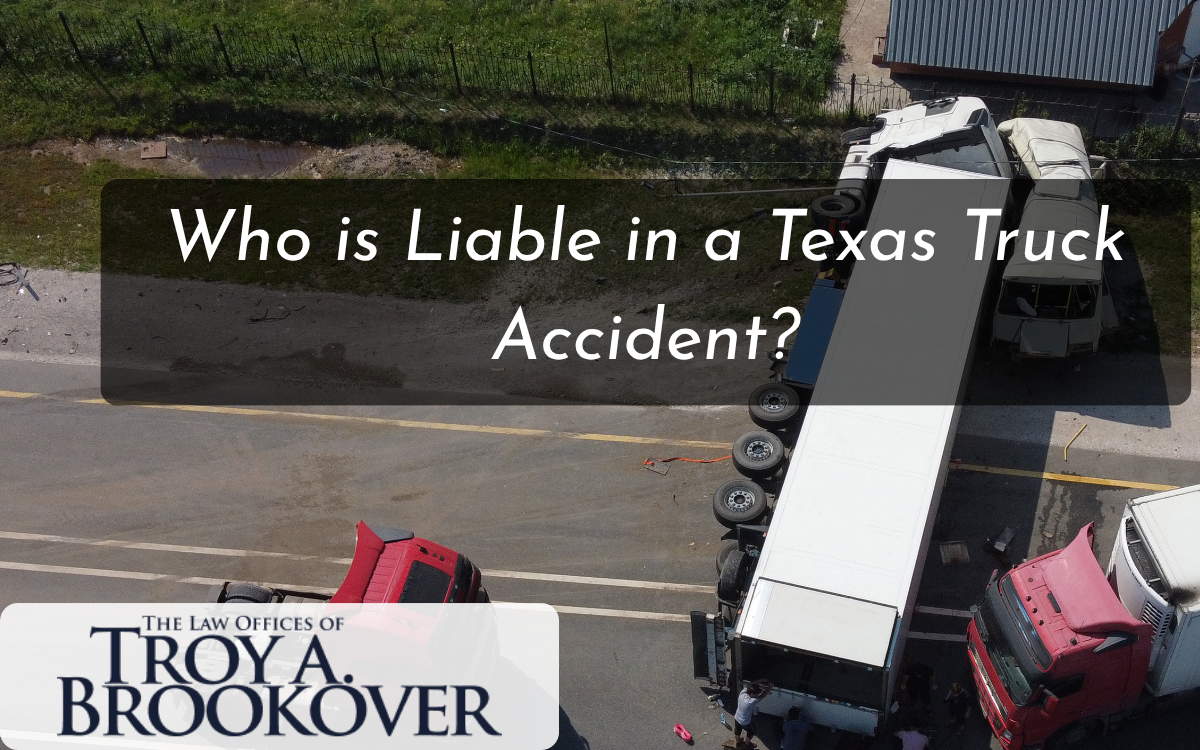
Determining liability is essential when seeking compensation after a Texas truck accident. The trucking industry includes many parties who may bear responsibility for a crash, such as the truck driver, the trucking company, cargo loaders, and more. Depending on the circumstances, you may be able to bring a claim against multiple parties, giving you more than one potential source of compensation. Maximizing your claim requires a thorough investigation and deep understanding of state and federal trucking regulations.
That’s where the Law Offices of Troy A. Brookover comes in. Firm founder Troy A. Brookover has 35 years of experience representing Texans injured in commercial motor vehicle accidents and has recovered millions of dollars for his clients. Past wins include a $1.5 million settlement for a woman who required shoulder surgery and wrist injections after a commercial vehicle ran a stop sign and a $1 million settlement in a truck accident wrongful death case. While past results do not guarantee future outcomes, they do demonstrate our ability to build and pursue complex, high-value injury claims effectively.
If you have questions about truck accident liability after an injury, call or contact our law firm today for a free consultation.
What Liability Means in a Texas Truck Accident Claim
Liability is a term that means legally responsible. In a truck accident claim, a person or party found liable for the wreck may be required to pay the victim for resulting losses. Common examples of compensation in a truck accident case include money for medical bills, lost wages, reduced earning capacity, pain and suffering, and property damage.
When the Truck Driver Is Liable
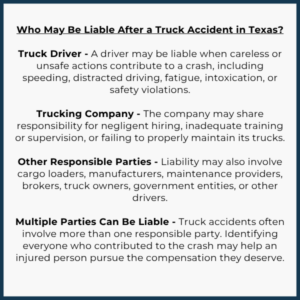
As the person most directly responsible for a truck’s safe operation, a driver may be liable for any mistakes they make that contribute to a crash. Truck driver liability may arise from:
- Speeding or driving too fast for conditions
- Reckless driving
- Distracted driving
- Fatigue driving
- Driving while intoxicated
- Violating hours-of-service (HOS) or other trucking safety regulations
- Following too closely or making unsafe lane changes
- Failing to inspect the truck or report known safety problems
- Ignoring traffic signals, signs, or right-of-way rules
- Driving without a valid commercial driver’s license
In Texas, a driver can be personally liable for a truck crash, though circumstances may allow the truck driver’s employer to share liability.
When the Trucking Company Is Liable
A trucking company may be liable in a truck accident claim under several circumstances. First, it may be held vicariously liable for a truck driver’s negligence under a legal principle called respondeat superior, which makes an employer liable for the on-the-job actions of its employee or agent. For example, the motor carrier may be responsible if the driver caused an accident while transporting cargo on the company’s behalf.
A trucking company may also face separate claims for its own misconduct, such as:
- Negligent hiring
- Failing to train or supervise its drivers properly
- Poor vehicle maintenance
Other Parties Who May Be Liable
In addition to the truck driver and trucking company, liability in a truck accident claim might rest with:
- A parts or truck manufacturer that made defective and unsafe vehicle components
- A third-party cargo loader that improperly loaded, balanced, or secured items onto a commercial truck
- A third-party maintenance company that failed to identify and replace worn components
- A shipping broker that knowingly hired a trucking company with a poor safety record
- A truck owner who failed to maintain their rig
- A government entity or subcontractor responsible for dangerous roadway conditions
- Another road user whose unsafe actions initiated the truck collision
Multiple Liable Parties
Sometimes, several different parties are partially responsible for a commercial truck accident.
Let’s say a trucking company hired a cargo crew without checking its safety record. The crew improperly loaded the cargo onto the truck, and the truck’s driver didn’t notice the problem because he skipped his mandatory pre-trip inspection. In this situation, all three parties — the trucking company, the cargo crew, and the truck driver — might be held liable for any resulting accident. An experienced truck accident lawyer representing the victim may include each party as a defendant in their lawsuit.
Federal and Texas Laws That Apply
Federal and state regulations may affect liability determinations in any given truck accident. These include:
- Hours-of-service rules ‒ Limit driving time and require rest periods to reduce fatigue-related crashes
- Driver qualification rules ‒ Govern driver qualification, training, medical fitness, driving history, and other eligibility requirements
- Drug and alcohol regulations ‒ Require testing under certain circumstances and prohibit drivers from operating while impaired
- Inspection and maintenance rules ‒ Require carriers to inspect, repair, and maintain trucks and equipment to keep them in safe operating condition
- Cargo securement standards ‒ Specify how cargo must be loaded and secured to prevent shifting or spills
- Texas traffic laws ‒ Establish traffic regulations and additional rules for commercial drivers and intrastate commercial vehicle operation
Proving Liability: What Evidence Matters
Examples of evidence that may apply to your circumstances include:
- Police reports
- Photos and videos of the accident scene
- Witness statements and deposition testimony
- Dashcam, traffic-camera, and surveillance footage
- Hours-of-service records and driver logs
- Electronic logging device (ELD) records
- The truck’s event data recorder or “black box” data
- Cellphone and dispatch communications
- GPS, telematics, and route-history data
- Driver qualification and employment records
- Truck inspection, repair, and maintenance records
- Bills of lading and delivery schedules
- Drug and alcohol test results
- Medical records
Evidence is essential to establish liability after a truck accident. Your truck accident attorney can conduct an extensive investigation and gather evidence to support your claim for compensation.
Comparative Negligence in Texas
Texas follows a modified comparative negligence rule, which means that a truck accident victim can still recover compensation as long as they are not more than 50 percent to blame for the crash. However, their compensation is reduced by their portion of fault.
Insurance companies may try to reduce your payout by arguing you share more fault for the crash than you actually do. A skilled truck accident lawyer can dispute unfair fault determinations and push for a settlement that reflects the true extent of your losses.
Contact Our Texas Truck Accident Liability Lawyers
 If you’ve been injured in a tractor-trailer crash, you need a lawyer with extensive experience to determine who is liable in a truck accident and advise on your next steps. Attorney Troy A. Brookover is Board-Certified in Personal Injury Trial Law by the Texas Board of Legal Specialization, a credential held by only about 6 percent of Texas lawyers. *
Call or contact the Law Offices of Troy A. Brookover today for a free consultation.
*Data accessed from the State Bar of Texas, August 2026